



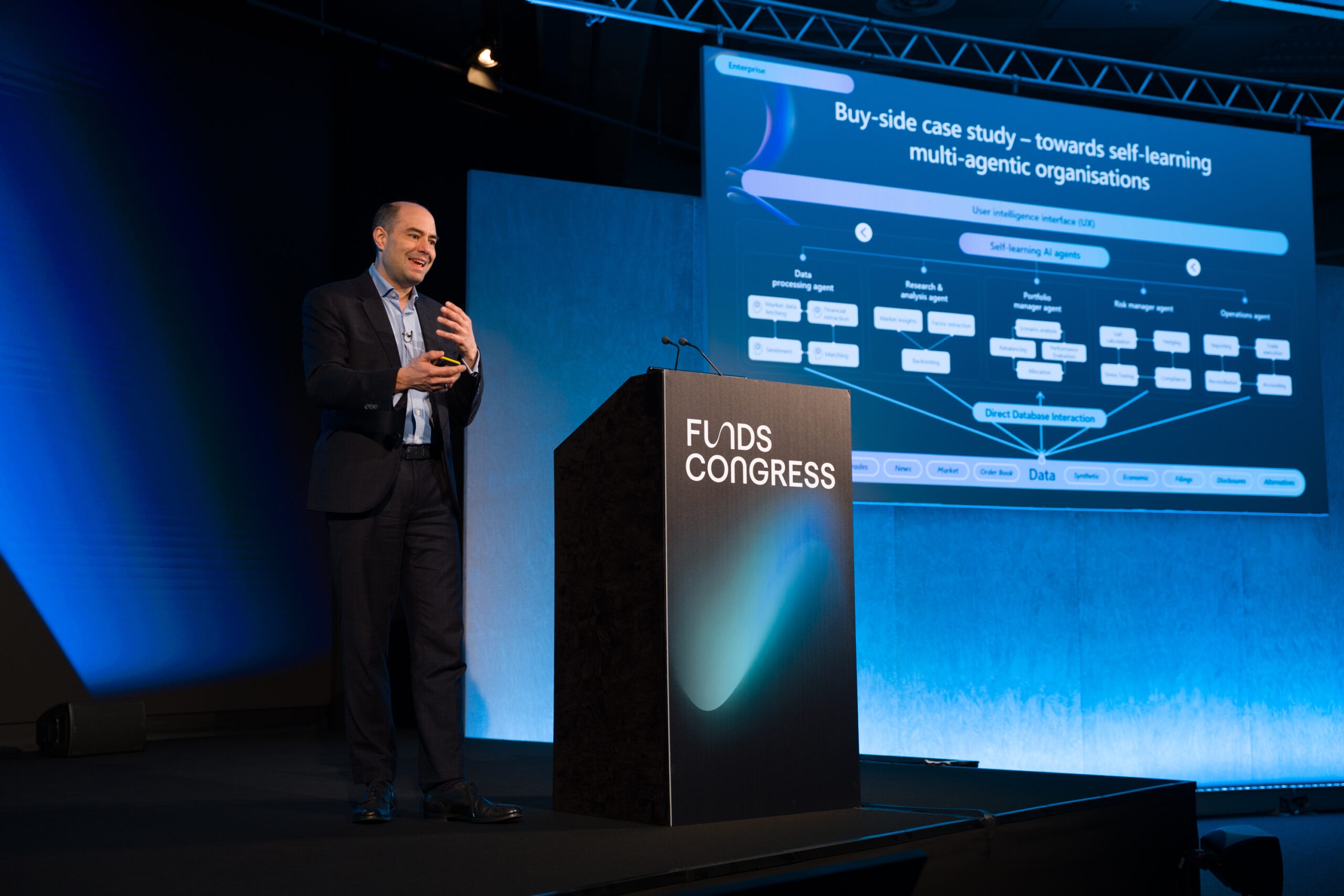
Microsoft Keynote: Dr. Marc Pfeiffer, EMEA Capital Markets Lead,
Microsoft
This keynote provided perspectives on AI transformation in asset management and how firms can realise return on investment by rethinking work, processes, and the broader ecosystem. Capital markets were positioned as historically at the forefront of technology adoption, with generative AI presented as the next major shift, particularly impactful for unstructured and private markets data.
Success requires focus on three pillars: employee productivity and skills,
enterprise and process redesign of workflows, and ecosystem development
through partnered platforms with faster go-to-market capabilities, all
underpinned by a secure, compliant technology foundation. Agentic
workflows allow delegation of knowledge work to systems, transforming
operating models where small teams combined with many agents can deliver outsized impact. The future human-computer interface will be natural language, orchestrating agents across underlying data and systems. Real value comes from process redesign and scaling on a common platform rather than isolated proofs of concept, governed for security, data access, observability, and responsible AI.
Major financial institutions have deployed AI at significant scale, with Barclays implementing approximately 100,000 Copilots, UBS approximately 50,000, and BlackRock approximately 25,000. Engineering productivity has reached approximately 35 per cent of code at Microsoft now written with AI assistance, whilst redesigned call centre scenarios have delivered approximately 500 million dollars per year in savings. Private markets represent an early AI focus, with wins in private equity and credit via unstructured document ingestion and analysis.
Moving beyond incremental productivity requires redesigning end-to-end
processes with AI and agents embedded. Private equity deal workflows can automatically analyse multi-format documents, extract key metrics, and draft initial investment committee memos, whilst digital investment committees enable members to query pre-read materials via natural language.
The ecosystem strategy connects buy-side, sell-side, market infrastructure, and data providers through partnerships with LSEG, DMI, Euroclear, SimCorp, BNY, State Street, Charles River, Carne Group, and Calastone. LSEG Digital Market Infrastructure has launched private assets as its first asset class, aiming to streamline private fund distribution and operations end-to-end.
Scaling requires security, data governance and access controls, agent
observability, and responsible AI, with firms shifting from scattered
experiments to a single scalable platform. A learn-it-all mindset requires
continuous upskilling on evolving model capabilities, with CEO-level ambition setting the ceiling for speed and scope of transformation.